Cobb & Company: Leadership & Mentorship in Addressing Health Disparities
This new podcast series from the W. Montague Cobb Institute features interviews with thought leaders and change makers who are ending health disparities, achieving equitable representation in the healthcare workforce, mentoring clinician scientists, and increasing diversity in clinical trial participation.
The Cobb Institute is an independent organization founded by the National Medical Association to lead research into racial and ethnic health disparities, and to advocate for solutions in five key areas: disparities awareness, workforce representation and resiliency, diverse participation in medical research, equitable access to healthcare, and equitable outcomes in healthcare.
Randall C. Morgan Jr., MD, MBA, President and CEO of the W. Montague Cobb Institute, is the lead host. Guest hosts will be drawn from Cobb Institute staff and from the Cobb Institute Board of Directors.
Dr. W. Montague Cobb was a distinguished professor of anatomy at Howard University, who combined a physician’s mindset with physical anthropology, anatomy research, and a lifelong commitment to mentoring medical students, physicians and scientists. He was determined to confront racial disparities in medicine, and to advance equitable representation across healthcare and the sciences.






Episodes
Oct 24, 2024
Oct 24, 2024
49 min
In this inspiring episode of Cobb and Company, recorded live at the National Medical Association Annual Convention in New York, host Rolf Taylor sits down with the remarkable Reverend Dr. Lucy Perez. Dr. Perez, a former president of the National Medical Association and a former director of the NAACP, shares her journey from her early career in New York's public health sector advocating for communities impact by HIV, to her current work in addressing health disparities and promoting diversity in clinical trials through her church.
Dr. Perez reflects on her encounters with the legendary W. Montague Cobb and her advocacy for social activism within the medical field. She passionately discusses the systemic biases in healthcare and the importance of equitable treatment for people of color. The conversation also delves into the innovative ways her church, Kingdom Fellowship AME Church, led by Pastor Matthew L. Watley, is engaging its congregation in health research and clinical trials, framing scientific discovery as a divine opportunity.
Tune in to explore the intersection of faith, health, advocacy, and activism, and learn how communities can harness the power of knowledge and trust to drive positive change. This episode is a call to action for securing time to reflect, engage, and create a more inclusive and equitable healthcare system.
(c) W. Montague Cobb Institute 2024 https://www.thecobbinstitute.org/w-montague-cobb
Kingdom Fellowship AME Church https://kingdom.global/
Oct 22, 2024
Oct 22, 2024
48 min
Join us in this in-depth episode as Rolf Taylor, producer of the podcast series, converses with Dr. Lisa Merritt at the National Medical Association Annual Assembly. Dr. Merritt, based in Sarasota, Florida, shares her journey as the first physiatrist on the podcast and delves into her impactful work as the Founder and Executive Director of the Multicultural Health Institute.
Dr. Merritt discusses her initiatives to address health inequities, the importance of community-based participatory research, and her passion for mentoring the next generation of medical professionals. With an herbalist uncle and a passion for combining traditional nutrition and modern medicine, Dr. Merritt discusses how the "whole person" approach benefits patients and communities. She also shares insights from her recent trip to Ghana, highlighting the importance of returning to one's roots to move forward again.
Discover how Dr. Merritt's work in Sarasota, focusing on chronic diseases and environmental justice, is reshaping healthcare delivery and community health. Her inspiring story is a testament to the power of cultural competence and community engagement in fostering health equity.
(c) W. Montague Cobb Institute 2024
The Multicultural Health Institute: https://www.the-mhi.org/news
Bio: Dr. Lisa Merritt
Dr. Lisa Merritt is a board-certified physiatrist, focusing on brain injury, pain management, including sports and work-related injuries in Sarasota, Florida. Over the past 25 years, she has been a passionate and unrelenting advocate for elimination of health disparities. In 1995, while managing her practice and serving as an Adjunct Assistant Professor at the University of California Davis, Dr. Merritt founded the Multicultural Health Institute (MHI) in Sacramento,California to focus attention on health disparities and the economic impact of prevention strategies. A former seven-year President of the Capitol Medical Society and Vice President of the Golden State Medical Society, Merritt was an original member of the California Office on Minority Health statewide multicultural health task force and originator of the initial policy on improving cultural and linguistics standards in health delivery in the State of California. Moving to Sarasota, Florida in 2004, Dr. Merritt in her practice and through the MHI, has had a singular impact on health disparities through two highly successful community initiatives; her Sarasota Community Health Guide and her creation of the Gatekeepers, lay health advisors and educators involved in neighborhood activities to reduce disparities in HIV/AIDS, diabetes, cancer and cardiovascular disease through preventive health measures that include providing information on health coverage, health awareness and health screenings.
Oct 22, 2024
Oct 22, 2024
37 min
In this foundational episode, Dr. Randall Morgan, an esteemed orthopedic surgeon and the President and CEO of the W. Montague Cobb Institute, engages in a captivating conversation with Dr. Alvin Crawford, the former Board Chair of the W. Montague Cobb NMA Health Institute. Recorded at the National Medical Association Annual Convention, the dialogue offers insights spanning eight decades of Dr. Crawford's extraordinary career and his transition from a music major to a pioneering figure in pediatric orthopedics.
Dr. Crawford shares the milestones of his journey, highlighting the influential role of mentors and the importance of perseverance. He reflects on the significance of the Cobb Institute's work in addressing health disparities and the impact of diverse multidisciplinary collaborations. The episode also explores the intriguing connection between music and medicine, as Dr. Crawford discusses his upcoming book, "The Bone Doctor's Concerto," which delves into the harmonious blend of his two passions.
Listeners will gain insights into the challenges and triumphs faced by African-American physicians, the vital role of mentorship, and the enduring legacy of trailblazers like Dr. Crawford and Dr. Morgan, both with "firsts" to their names. This episode is a testament to the power of resilience, dedication, and the pursuit of excellence in both music and medicine, and to the importance of the work of the W. Montague Cobb Institute.
(c) W. Montague Cobb Institute 2024
The Bone Doctors Concerto https://a.co/d/6wijZsp
W. Montague Cobb Institute https://www.thecobbinstitute.org/w-montague-cobb
Oct 17, 2024
Oct 17, 2024
31 min
In this enlightening episode of Cobb & Company, the podcast of the Montague Cobb Health Institute, hosted by Rolf Taylor, our guest is Dr. Winston Price, M.D., FAAP, Chief Information & Technology Officer, delves into the transformative impact of the Cobb Scholars Program. Designed to foster diversity in healthcare research, the program aims to empower young healthcare professionals by providing them with access to mentoring, resources, research project (R01) grants & funding, and networking opportunities.
Dr. Price, a board-certified pediatrician and past president of the National Medical Association, shares insights into the program's mission to address disparities in research funding and representation. He highlights the importance of connecting young scholars with seasoned mentors and prestigious platforms like the Association of Academic Minority Physicians to advance their careers.
Listeners will also gain a deeper understanding of the Cobb Institute's efforts to leverage data from the All of Us Research Program, housed at the Vanderbilt Data Warehouse, to enable groundbreaking research on health disparities. Dr. Price emphasizes the program’s commitment to nurturing the next generation of physician-scientists, advocating for bold and unapologetic efforts to improve healthcare for all.
Closing the discussion, Dr. Price reflects on the immense legacy and influence of Dr. Montague Cobb, a physician-scientist who was instrumental in establishing Medicare and Medicaid, for the benefit of all Americans.
(c) W. Montague Cobb Institute 2024
Oct 14, 2024
Oct 14, 2024
54 min
In this insightful episode of Cobb and Company, Dr. Randall Morgan, President and CEO of the W. Montague Cobb Health Institute, welcomes Dr. Richard Allen Williams, a pioneering figure in medicine and advocate for diversity and equity. The episode delves into the history and impact of influential mentors like Dr. W. Montague Cobb, and highlights the importance of preserving their legacy. Dr. Morgan and Dr. Williams remember Dr. Cobb's vital role as a physician and Howard University professor advising The White House during the early 60s, when civil rights and voting rights legislation were enacted, and Medicare and Medicaid were established.
Dr. Williams reflects on the significance of his recent street naming honor in Wilmington, marking a full-circle moment in his illustrious career, and shares his journey from his early aspirations inspired by a kind pediatrician in Wilmington to becoming a renowned cardiologist and the founder of the Association of Black Cardiologists.
He discusses the challenges and triumphs of being one of only a handful of African Americans among thousands of white students attending Harvard University at the age of 16, sharing valuable insights and advice for aspiring medical professionals. He also emphasizes the crucial role of mentorship and sponsorship in advancing diversity in medicine today.
Join podcast host and Cobb Institute CEO Dr. Randall Morgan in conversation with Dr. Williams as they explore the intersection of music and medicine, and discuss the ongoing efforts to ensure that the contributions of African American medical professionals are recognized and celebrated.
-----
In 1974, Richard Allen Williams, MD, FACC founded the Association of Black Cardiologists (ABC) with 17 other dedicated medical professionals. https://abcardio.org/
The W. Montague Cobb/National Medical Association (NMA) Health Institute (The Cobb Institute), a 501(c)(3) in Washington, DC, functions as a national consortium of scholars that engages in innovative research and knowledge dissemination for the reduction and elimination of racial and ethnic health disparities and racism in medicine. https://www.thecobbinstitute.org/about-us
(c) W. Montague Cobb Institute 2024
Aug 23, 2024
Aug 23, 2024
54 min
In this episode of Cobb & Company, recorded live at the National Medical Association Annual Convention and Scientific Assembly in New York, Dr. Randall Morgan, President and CEO of the W. Montague Cobb Health Institute, sits down with Dr. Geoffrey Young from the Association of American Medical Colleges (AAMC). They discuss the AAMC's new strategic action plan aimed at diversifying the healthcare workforce.
Dr. Young, who leads the AAMC’s Transforming the Healthcare Workforce portfolio, shares insights into the organization's efforts to engage younger learners, particularly those from historically marginalized communities, in pursuing careers in healthcare. He highlights the importance of establishing pathway programs, developing educational resources, and fostering community partnerships to create a more inclusive healthcare workforce.
Additionally, Dr. Young and Dr. Morgan delve into the challenges and opportunities within K-12 education, the role of community colleges, and the critical need for academic health centers to engage with their local communities. They also discuss the impact of the recent Supreme Court decision on diversity, equity, and inclusion initiatives in medical education.
Tune in to learn about innovative strategies, successful programs, and the ongoing efforts to ensure that the future healthcare workforce is diverse, well-prepared, and capable of meeting the needs of all communities.
Dr. Young leads the Transforming the Health Care Workforce portfolio, an extension of his responsibility leading the AAMC’s Strategic Action Plan 4, which seeks to diversify the health care workforce.
His portfolio’s work is focused on the education, professional development, and wellness of future health care workers and on creating viable pathways for historically marginalized communities to enter the health care profession.
Focus areas include disseminating research and data that provide insights on trends, structural inequities, and institutional culture that impact the diversity of the health care workforce and scanning the full medical education continuum to highlight promising practices, leverage points of intersection, and inform resource development that support innovations to UME and GME.
His team is also recognized as a leader in holistic review in selection and pre-medical and applicant resources, providing inspiration, resources, data, and tools so that anyone can aspire to a career in medicine.
Before joining the AAMC in 2011, Geoffrey served in leadership positions in medical school admissions and student affairs at Rutgers University-Robert Wood Johnson Medical School, Virginia Commonwealth University School of Medicine, and the Medical College of Georgia at Augusta University. Dr. Young earned his B.A. from Hampton University and his M.A. and Ph.D. in clinical psychology from the Ohio State University.
Randall C. Morgan, Jr., MD, MBA, is the President and CEO of the W. Montague Cobb/NMA Health Institute based in Washington, D.C. In that role he leads a staff of scholars and research specialists who focus upon the elimination of Health Disparities. He is also an active orthopedic surgeon who has practiced in Sarasota and Bradenton, Florida since 2005. He serves as founder and President of University Park Orthopedics in that community. He is also Clinical Associate Professor of Orthopedic Surgery at Florida State School of Medicine and is also a Clinical Associate Professor in the Department of Community Medicine at the University of Connecticut. He is a graduate of Grinnell College with a B.A. in Chemistry. He received the M.D. degree from Howard University. He served as a resident in Orthopedic Surgery at Northwestern University and served a Pediatric Orthopedic Fellowship at Children’s Hospital in Cincinnati. He later received an MBA degree from the University of South Florida.
Dr. Morgan served as the 95th President of the National Medical Association during the years 1996 and 1997. He was the first board-certified orthopedic surgeon to hold that position. Dr. Morgan is a true pioneer in his profession and was among the first surgeons to perform total joint replacement surgery at Northwestern University. Dr. Morgan has practiced General Orthopedic Surgery and Pediatric Orthopedics in Evanston, Illinois, and as well in his hometown of Gary, Indiana, for more than 30 years prior to his relocation to Sarasota. With the assistance of his father, Mr. Randall C. Morgan, Sr., he founded the Orthopedic Centers of Northwest Indiana and served as its president from 1975 to 1999. At one time, this was the largest minority-owned orthopedic practice in the United States. He has written and published extensively throughout his career on Orthopedics, Social Responsibility, Health Equity and the Education Pipeline for Underrepresented young scholars. He is a Diplomat of the American Board of Orthopedic Surgery and the American Board of Managed Care Medicine. He is also a Fellow of the American College of Surgeons and a member of Alpha Omega Alpha honorary medical society.
(c) W. Montague Cobb Institute https://www.thecobbinstitute.org/w-montague-cobb
AAMC ACTION PLAN: https://www.aamc.org/about-us/strategic-plan/action-plan-4-increase-diversity-medical-school-applicants-and-matriculants
Aug 22, 2024
Aug 22, 2024
49 min
Dr. Cedric Bright has been described colleagues as a resident-recruitment “secret weapon" because of his passion - and how difficult it is to turn him down. He has been involved in college admissions since his early career, helping recruit students during his residency at Brown University. Join us as Dr. Bright discusses his journey from Brown to Duke University, the Durham VA, and the Brody School of Medicine at East Carolina University, with podcast host Dr. Randall Morgan, President and CEO of the W. Montague Cobb Institute. Dr. Bright highlights the challenges and successes in recruiting and retaining Black medical students and faculty, the importance of cultural humility, and the transformative power of intentionality in medical education. Dr. Morgan and Dr. Bright also reflect on the legacy of W. Montague Cobb, comparing his stature in the 1960s to that of President Barrack Obama today.
Dr. Cedric Bright, is a general internal medicine physician. He is Senior Associate Dean for Admissions and Professor of Medicine at The Brody School of Medicine at East Carolina University.
He was previously Associate Clinical Professor of Internal Medicine and Community and Family Medicine at Duke University and a staff physician at the VA Medical Center in Durham. Dr. Bright also served on the North Carolina Medical Society Patient Safety Taskforce; chaired the board of directors at the Lincoln Community Health Center; has spoken about health disparities before the Congressional Black Caucus; was a medical ambassador to Ghana; and has served as a mentor for the Student National Medical Association.
Dr. Bright is a dedicated leader in delivering patient equity through broader access, and is a staunch proponent of healthcare reform. He is a published author, lecturer, and thought leader on current trends and best practices in healthcare, healthcare policy and management, medical education, health equity, and DEI issues.
Randall C. Morgan, Jr., MD, MBA, is the President and CEO of the W. Montague Cobb/NMA Health Institute based in Washington, D.C. In that role he leads a staff of scholars and research specialists who focus upon the elimination of Health Disparities. He is also an active orthopedic surgeon who has practiced in Sarasota and Bradenton, Florida since 2005. He serves as founder and President of University Park Orthopedics in that community. He is also Clinical Associate Professor of Orthopedic Surgery at Florida State School of Medicine and is also a Clinical Associate Professor in the Department of Community Medicine at the University of Connecticut. He is a graduate of Grinnell College with a B.A. in Chemistry. He received the M.D. degree from Howard University. He served as a resident in Orthopedic Surgery at Northwestern University and served a Pediatric Orthopedic Fellowship at Children’s Hospital in Cincinnati. He later received an MBA degree from the University of South Florida.
Dr. Morgan served as the 95th President of the National Medical Association during the years 1996 and 1997. He was the first board-certified orthopedic surgeon to hold that position. Dr. Morgan is a true pioneer in his profession and was among the first surgeons to perform total joint replacement surgery at Northwestern University. Dr. Morgan has practiced General Orthopedic Surgery and Pediatric Orthopedics in Evanston, Illinois, and as well in his hometown of Gary, Indiana, for more than 30 years prior to his relocation to Sarasota. With the assistance of his father, Mr. Randall C. Morgan, Sr., he founded the Orthopedic Centers of Northwest Indiana and served as its president from 1975 to 1999. At one time, this was the largest minority-owned orthopedic practice in the United States. He has written and published extensively throughout his career on Orthopedics, Social Responsibility, Health Equity and the Education Pipeline for Underrepresented young scholars. He is a Diplomat of the American Board of Orthopedic Surgery and the American Board of Managed Care Medicine. He is also a Fellow of the American College of Surgeons and a member of Alpha Omega Alpha honorary medical society.
Aug 21, 2024
Aug 21, 2024
46 min
In this insightful episode of Cobb & Company, Dr. Randall Morgan, President and CEO of the W. Montague Cobb Institute, hosts an engaging discussion on the transformative power of mentorship in the medical field. Recorded live at the 2024 NMA Convention and Scientific Assembly in New York, Dr. Morgan is joined by Dr. Lynne Holden and Dr. Dexter Frederick, two distinguished leaders who share their personal journeys and the critical role of mentoring in fostering diversity in healthcare.
Dr. Holden, a Professor of Emergency Medicine and Senior Associate Dean of Diversity and Inclusion at Albert Einstein College of Medicine, reflects on her 40-year mentorship with Dr. Muriel Petioni and the impact of her nonprofit organization, Mentoring in Medicine. Dr. Frederick, Associate Dean of Diversity, Equity, and Inclusion at Loma Linda University Health School of Medicine, discusses the origins and success of the Brain Expansion Scholastic Training (BEST) program.
The episode delves into the challenges of securing funding, the importance of community-based organizations, and strategies for replicating successful mentorship programs across the nation. Tune in to learn how these leaders are navigating the evolving landscape of healthcare education and working to ensure a diverse and equitable future for the medical profession.
Dr. Lynne Holden is Professor of Emergency Medicine at the Albert Einstein College of Medicine in the Bronx, NY and a practicing Emergency Department Physician Attending at Montefiore Health System on the Moses Campus. Dr. Holden is Senior Associate Dean of Diversity and Inclusion at the Albert Einstein College of Medicine.
She earned her B.S. in Zoology from Howard University, graduated from Temple University School of Medicine, and completed her residency in Emergency Medicine at the Albert Einstein College of Medicine, the start of a long association. She is a member of Delta Sigma Theta, Inc. and WellMet, a female giving circle that supports social justice organizations.
Dr. Holden is also the co-founder and President Emeritus of Mentoring in Medicine, a national nonprofit organization dedicated to inspiring and equipping students to become health care professionals through academic enrichment, leadership development, civic engagement, and mentoring. Through conferences, hip-hop plays, school-based, and virtual programs, Mentoring in Medicine has reached nearly 85,000 students from elementary school through to medical school. While nearly 1,200 program participants have pursued a variety of biomedical careers, 572 have become doctors. Dr. Holden is a member of the Board of Directors at the W. Montague Cobb Institute.
Dr. Dexter Frederick was appointed Associate Dean of Diversity, Equity, and Inclusion at Loma Linda University Health's School of Medicine in California. He is also an Associate Professor of Pediatrics and Medicine at the university.
Dr. Frederick is a board-certified physician in both internal medicine and pediatrics, and is a Fellow of the American College of Physicians and a diplomat of the American Board of Pediatrics. He also has a certificate in Diversity and Inclusion from Cornell University's School of International and Labor Relations.
Dr. Frederick is the Founder and CEO of the Brain Expansions Scholastic Training (BEST) Organization; a community-based initiative whose mission is to identify, inspire, and educate underrepresented youth interested in pursuing health careers. Over the past two decades, the BEST Organization has developed medical pathway programs that provide mentorship, guidance, and support for students of color. Dr. Frederick is also a board member at the Montague Cobb Institute.
Excerpts
“I did not have any physicians in my family, and it was my aunt who introduced me to Dr. Muriel Petioni, and Dr. Petioni was my mentor for over 40 years. Just to be able to see the way that she advocated for her patients and for the community was so important.”
“The BEST program, which stands for Brain Expansion Scholastic Training, is really my journey personally. It started out with the opportunities I got as a teenager with my mom opening some doors for me to allow me to be in the hospital. It's a journey through college where I had to overcome some challenges and setbacks. It's a journey during my gap year, I kind of rebounded and had that confidence come back again. It's a journey through med school where I had to kind of shift as all medical students have had to do, shift how you learn and study.”
“We have to get creative and smart about how to continue these programs, remembering what the climate is like now and what it may be in the future. For us to continue to work, we've got to have private philanthropy funding and also corporate funding that does not really get mixed with governmental political discussions. For example, the National Science Foundation, National Institutes of Health, for every grant that's submitted, they really want to have a dissemination plan and also know how they want you to have a plan for how you're going to reach underrepresented minority students.”
“Institutions, medical schools, for example, are really starting to lean into community-based organizations to help them to fulfill those requirements. And I think that it's important for us to take what we discussed today and to put it in a form that can be shared with the membership of the National Medical Association so that people can and understand what they can do in their own communities.”
Timeline
0:00 Excerpts
2:30 Introductions
7:30 Dr. Holden describes her experience of being mentored for decades by Dr. Muriel Petioni, known as the "mother of medicine in Harlem," from age 13.
11:00 Dr. Morgan asks if it is now harder than it was to get access to learning situations such as shadowing. Dr. Holden describes ways that mentoring programs make this possible.
13:00 Dr. Frederick describes his experience of being a mentor to an aspiring medical student experiencing challenges to completing medical school, and how that support helped towards a positive outcome.
17:00 Dr. Holden describes challenges and successes in getting Mentorship in Medicine, a non-profit initiative, off the ground, and how finding funding is key.
22:00 Dr. Frederick describes the start of the BEST program and how it developed into a successful program with national reach, in parallel with his own career development and involvement with workforce diversity.
27:00 Dr. Holden discusses expansion of Mentoring in Medicine to multiple cities and states, and internationally online.
30:00 Dr. Frederick discusses sharing best practices and program templates with partner organizations such as hospitals.
32:00 Dr. Holden discusses restrictive legislation impacting initiatives and how this affects program implementation and funding.
33:30 Dr. Frederick comments on importance of independent community based organizations funded through private philanthropy during a time when universities are being restricted by state policies.
35:30 Dr. Morgan introduced information about the Cobb Symposium that will focus on best-in-class mentoring programs and how they will be affected by the new environment in the USA, following the supreme court opinion of 2023 on affirmative action. Dr. Frederick and Dr. Holden discuss.
39:00 Dr. Holden reiterates the importance of community organizations for reaching medical students with information from federally funded programs.
41:00 Dr. Morgan discusses the importance of the NMA as a community of advocates able to participate in information dissemination and mentorship. He describes W. Montague Cobb's commitment to education and mentorship to impact communities.
44:00 Dr. Holden reflects on Dr. Cobb's impact. Dr. Frederick describes the need to allow humanity to be its best self and follow the example of Dr. Cobb. He reflects on Dr. Cobb's career and accomplishments, and his navigation of segregation.
45:00 Closing remarks.
© Copyright Project Advocacy 2024
Aug 20, 2024
Aug 20, 2024
37 min
The supreme court opinion on affirmative action over a year ago brought challenges to pipelines and pathways programs. During that time additional legislation has also closed offices of DEI. Outgoing NMA President Dr. Yolanda Lawson discusses the implications of a changed environment during a discussion at the NMA 2024 Convention and Scientific Assembly with Dr. Randall Morgan, President and CEO of the Montague Cobb Institute.
Together they highlight the urgent need to place greater emphasis on mentorship, linking this to outcomes, and to refining the value proposition for building a diverse workforce providing racially concordant care. During the discussion Dr. Lawson calls for a major pivot to mentorship, and highlights the need for more NMA members to become mentors. Dr. Lawson describes her efforts as NMA President to establish a formal mentorship network, and to initiate local mentorship collaborations between NMA State and local societies and educational institutions.
Dr. Yolanda Lawson, MD, FACOG, is a Doctor of Medicine and a Fellow of the American College of Obstetricians and Gynecologists. She was previously the founder and leader of MadeWell Obstetrics and Gynecology in Dallas, Texas, and an Associate Attending Physician at Baylor University Medical Center. Dr. Lawson is deeply committed to the issue of health disparities of Black women and common issues faced by Black physicians. She addresses maternal health, cardiovascular issues, and HIV/AIDS. Her focus also includes the study of how to use digital innovation to close the gap in healthcare disparities faced by Black people, and the impact of health care in the workforce of Black physicians, including racism and burnout.
In addition to her Presidency of NMA in the past 12 months, Dr. Lawson recently became Executive Medical Director of Maternal Infant Health at the Health Care Service Corporation, an organization that is dedicated to improving access to care and targeting social and economic factors that influence health.
Excerpts
“Affirmative action was in place and we still were not able to achieve our goals of racially concordant care and having enough Black physicians to take care of the population in this country, even with affirmative action.”
“One of the things we have been talking about this past year is creating a formalized national mentoring network.”
“Many students have an expectation that mentors need to be reaching out to them. You need to assert yourself as a mentee - that is a very important nuance for all individuals to understand.”
“With legislators, when you talk about workforce, that engages others…the hospital lobby, industry, pharmaceuticals, the pharmacist, it engages nursing, it engages the heart of the engine. Everyone is interested in the outcomes piece because there is a cost to that.”
“What is the value proposition for me or for them to make investments to reduce these disparities? That piece has to be refined, that is the whole point.”
Timeline
0:00 Excerpts
2:00 Introductions
4:00 Talking points for the NMA/Cobb Annual Symposium: “Then and Now, Navigating Best in Class Mentoring Innovation.
6:00 Importance of mentorship at all stages of career development. National mentorship network. How to select, train and support mentors.
8:30 Expanding the public health workforce and integration with HBCUs. Inviting public health students interested in health disparities to get involved with NMA. Structured opportunities for mentorship.
10:00 Insights from Cobb Scholars program: many scholars but a shortage of mentors. Call for more NMA members to become mentors. Opportunity to work with the sections of NMA and invite them to put forward mentors to create a network of mentors.
12:00 Importance of being assertive and proactive as a mentee, the need to ask directly for mentorship instead of waiting for busy people to reach out.
14:00 Opportunity to encourage SNMA members to partner with the state and local societies of the NMA to establish local mentoring relationships.
16:00 Concerns about the reduction in the public health workforce since COVID, CDC and other organizations responses.
18:00 Sometimes students do not get into medical school. Studying public health as an alternative path. Thinking about healthcare careers broadly.
20:00 Educational institutions are seeking partnerships at the local level to enable diverse workforce development through partnerships with organizations such as NMA. Collaborations to enable these partnerships.
22:00 Since the affirmative action opinion, has a consensus emerged for more effective ways that organizations and educational institutions can increase the numbers of underrepresented populations? Impact of legislation on DEI in Texas. Developing offices of Inclusion and Belonging to replace DEI.
24:00 Building consensus across multiple organizations to create an advocacy block. Concerns about medical education debt as a barrier to healthcare careers.
26:00 What messages resonate with legislators around workforce diversity? The value proposition and ROI for workforce diversity development and disparities reduction. The power of the business case.
30:00 Remembering Dr. Montague Cobb and how his approach inspires current thinking. The importance of the Civil Rights Act 1964, ending hospital and medical segregation. Dr. Cobb's writing on the Civil Rights act in the JNMA and expectations for impact on healthcare. How Dr. Cobb led with equity, civil rights, and how current students may not understand the importance of this history.
34:00 Dr. Morgan remembers being an anatomy student of Dr. Cobb in 1965, and not realizing until years later that Dr. Cobb was a pivotal figure in NMA and other organizations. How President Joe Biden was inspired by the Civil Rights Act and his friendship with Dr. Richard Allen Williams to enter politics.
38:00 Closing remarks.
May 9, 2024
May 9, 2024
44 min
Immerse yourself in the insightful wisdom of Dr. Rodney Hood and Dr. Randall Morgan as they explore critical facets of health equity, inclusive business alliances, and the role of community-based programs in healthcare. In this episode, we delve into the framework of The W. Montague Cobb Institute and how it spearheads initiatives to combat racial and ethnic health disparities and tackle racism in medicine.
Accompany us on an inspiring journey through their personal and professional lives, peppered with unique perspectives garnered from working across various American cities like Boston, Chicago, San Diego, and Florida. Get a behind-the-scenes look at their efforts in understanding the future priorities of the National Medical Association, fostering inclusivity, and weaving health equity into the core fabric of healthcare business ventures.
We spotlight Dr Rodney Hood's innovative "Multicultural IPA," a groundbreaking business model that champions cooperation among different ethnic groups and healthcare providers, serving as a lifeline for underserved communities. Their valuable insights sketch out a roadmap for a more egalitarian and interconnected healthcare network that can potentially revolutionize health disparity interventions.
This episode also explores the formation of the COVID Equity Task Force. A multicultural approach meant to bridge the racial disparities in health exacerbated by the pandemic, this initiative successfully engaged and influenced county and state officials, yielding tangible results in the fight against health inequities.
This episode underscores the importance of integrity, ingenuity, trust-building, and enduring alliances in achieving health equity. Positioned at the intersection of social justice and healthcare, the conversation emphasizes the necessity of modernizing traditional strategies to meet today’s challenges.
The episode concludes with a focus on empowering the next generation in the health equity movement. By leveraging new communication platforms and methodologies, they explore the importance of bridging the gap between research and community implementation—a gap where the Cobb Institute can make a tangible difference through its focus on mentoring underrepresented minorities into health equity research.
Video Recording of Cobb Symposium at NMA: https://www.facebook.com/BlackDoctor.org/videos/311280798015597
W. Montague Cobb Institute: https://www.thecobbinstitute.org/about-us
Multicultural Health Foundation: https://mhfwellness.org/

About the W. Montague Cobb Institute
History and Purpose
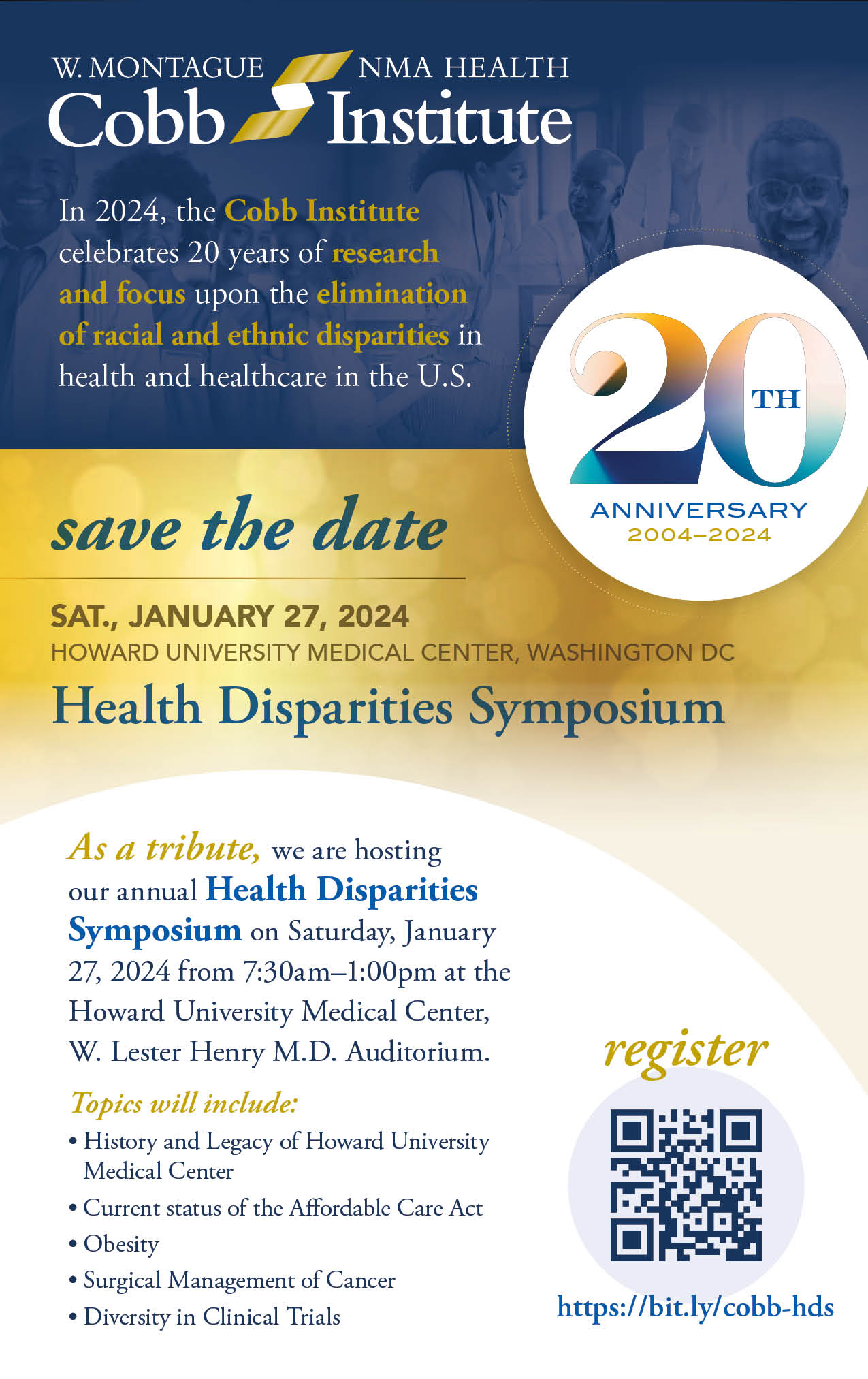
The W. Montague Cobb Institute (The Cobb Institute) functions as a national consortium of scholars that engages in innovative research and knowledge dissemination for the reduction and elimination of racial and ethnic health disparities and racism in medicine. Solving one of our society’s most pressing problems, racial inequities in health, requires the collaborative work of public agencies, private entities, academic medical centers, and -- equally important -- communities. Founded in 2004, The Institute is named in honor of the late William Montague Cobb M.D., Ph.D., physician, anthropologist, and a distinguished professor of medicine and anatomy. Dr. Cobb influenced countless graduates of Howard University School of Medicine, including Randall C. Morgan, Jr., M.D., M.B.A. who is an orthopedic surgeon and Founding Executive Director of The Cobb Institute.
OUR VISION
The Vision for The Institute is to change the landscape of population health by becoming a valued resource for ethical, inclusive research and data-driven solutions and strategies pertaining to racial and ethnic health and health disparities and racism in medicine.
QUICK LINKS
History and Mission | 2023 NMA Convention  | Cobb Scholars Program |  2024 Health Disparities Symposium
NIH All of Us Research Program & Researcher Workbench | DONATE | DAF Direct Giving|
Journal of Racial and Ethnic Health Disparities | Honoring William Montague Cobb, M.D., Ph.D.